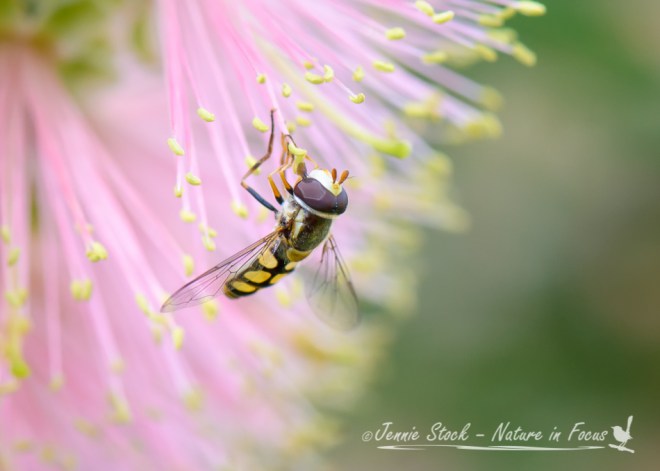
I was practising with my new macro lens on this bottlebrush or callistemon flower in the garden when a tiny fly decided to join the party. I often don’t notice the bugs until I start focusing on the flowers with my camera – perhaps I need to wear my glasses when I want to look specifically for small insects. I am impressed with the macro lens (Nikon 105mm), although I did get good results with the 60 mm (just need to be that bit closer).
Bee on red callistemon
Burchardia congest (milkmaid) with shiny insect
Native wisteria and bee
Bold Park dragonfly
With the bigger insects, like bees and dragonflies, I usually do see them unaided – of course, getting sharp shots is still a bit of a challenge. My real bugbear is butterflies – every time I try to focus they flit away – but I did manage one decent butterfly image this year. Sometimes I think I should stick to the big slow caterpillars!
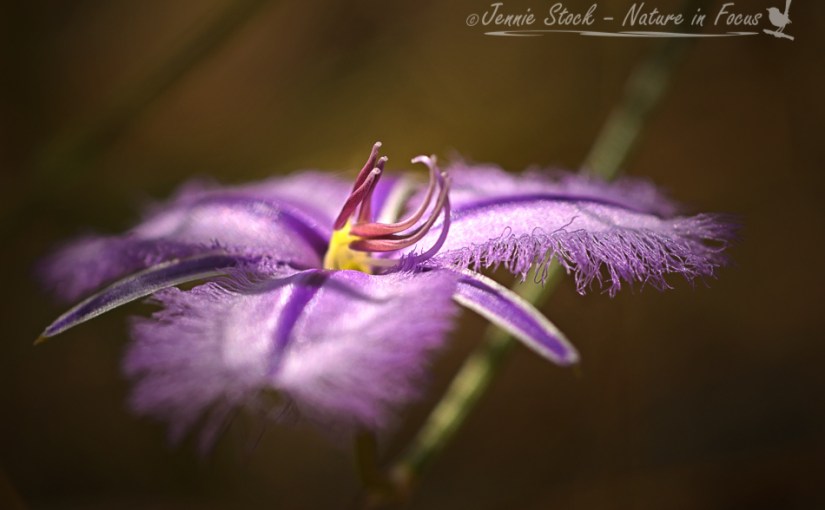
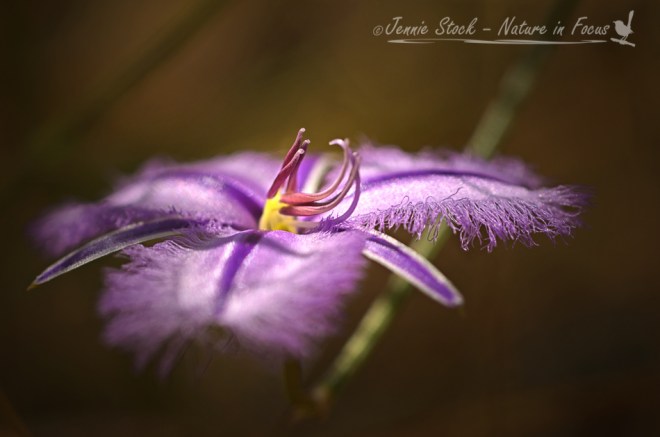
Western Australia has an amazing variety of wild flowers, many of them unique to the region. Spring is unsurprisingly the optimum time for chasing flowers with your camera, but there is almost always something flowering at any time of the year. Some, like the fringe lily above and a few in the selection below, are tiny and need some careful hunting to find. They also often involve strange contortions to photograph, which is fine when they are in our own garden or in a quiet patch of bush, but can lead to funny looks at more public places like Kings Park.
Stylidium – or triggerplant, also considered a carnivorous plant.
Stylidium close-up
Droopy daisy
Pretty in pink – unfortunately not sure what this is.
Pimelea spectabilis
Pink drosera flower – very tiny sundew (carnivorous plants).
This next selection includes some of the distinctively Australian plants, such as grevilleas, banksias, eucalypts and verticordias. These are often much bigger plants with easily recognisable flowers, although some can still be tricky to identify correctly. Very interesting plants and flowers, I sometimes find it quite challenging to do them justice – getting a photographically appealing image that is still recognisable (to my botanist hubby, particularly) is not always easy. And of course, we won’t mention the dratted breezes, the enemy of all flower photographers!
Grevillea thelemanniana flower with raindrops
Banksia hookerania
Pear-fruited mallee (Eucalyptus pyriformis)
Mystery myrtaceous flower from Ninghan Station
Verticordia grandis near Eneabba
Prickly leaves and pretty flowers – still need to figure out what it is.
Landscape photography is often about the “Golden hours” just after sunrise and just before sunset. Taking photos at these times in Kruger was a bit of a challenge as this is also prime game watching time. I stayed back in camp at Skukuza one morning to take this sunrise shot of the old railway bridge over the Sabie River and am very glad I made the effort. The view would be familiar to anyone who has spent time there; this version at least has some interesting lighting although the sunrise could have been a tad more spectacular. This was done in traditional landscape fashion, f/16 with a tripod and graduated ND filters.
Bushveld sunrise
Silhouette at sunrise
I did manage one sunrise with some vibrant lighting – the wide shot was taken with my landscape lens and quite a slow shutter speed, a bit hair-raising in a vehicle with three other people under strict instructions not to wriggle. A little later during the early morning game drive I managed to position myself to get the sun behind a silhouetted tree – taken in quite a hurry , handheld with my birding lens and the aperture wide open to keep the shutter speed up for sharpness.
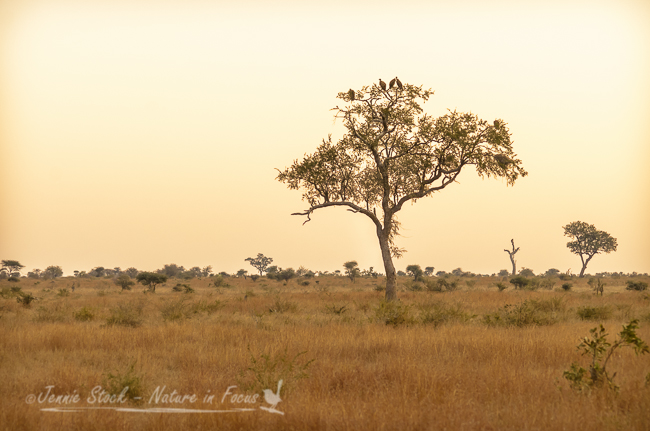
African savanna evening light
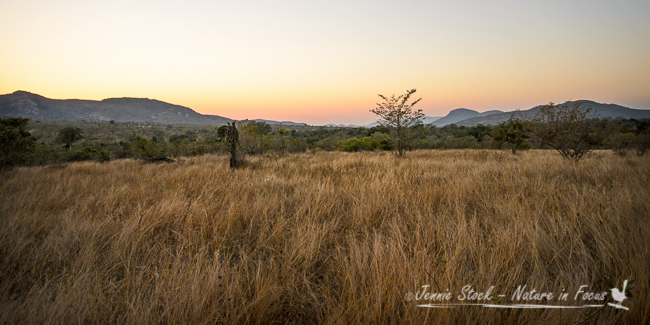
Rushing back to camp before the gates close in the evening and still hoping for that elusive lion or cheetah sighting is not really the ideal time for landscapes, but I couldn’t resist the lone tree in the savanna at sunset; another image using the short end of my birding lens. The Berg-en-dal sunrise was a bit more planned – taken from the vehicle using a bean bag for support, using my wide angle lens to capture the lovely soft light over the mountains. A fitting farewell image on our last morning.
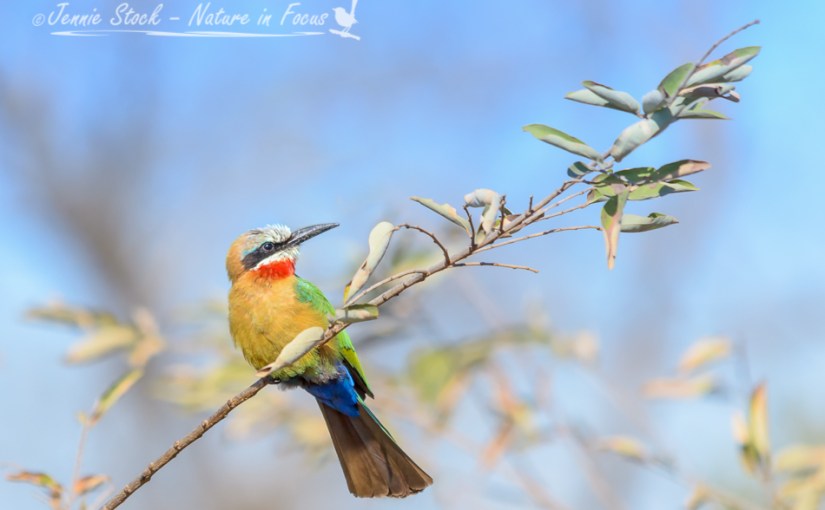
One of my favourite things about Kruger is the amazing variety of birds found in the bushveld; absolute heaven for a self-confessed bird nerd. The interesting perches chosen by the birds add to the photographic potential.
Yellow-billed oxpecker perched on Cape Buffalo
Long-tailed shrike precarious on thorn bush
Fork-tailed drongo sitting pretty among the acacia thorns
The use of the rolling hide (aka your car) is great for many birds as they are much less wary than they would be of someone on foot. The only hassle is when you come across birds like the spurfowl; often only visible when on the road, they are quite tricky to capture as they are too close and at an odd angle. Here I’ve tried a close-up portrait, with a background layer of the birds disappearing into the long grass.
Portrait of a Swainson’s spurfowl
Vultures circling far away
One disappointment bird-wise was only seeing vultures from a distance; for example, this large group circling, possibly over a kill, well away from the roads.The waterbirds were more cooperative; the Egyptian goose posed beautifully on one leg and the Hamerkop provided some interesting action while trying to land on a vanishing hippo – see one of my previous posts for more on that .
Egyptian goose with reflection
Hamerkop landing (or not)
My last two images were taken at places where you can get out of your vehicle. The barbet was playing hard to get, so this was the best I could manage. In contrast, the hornbills are fairly tame and quite easy to photograph at picnic sites.
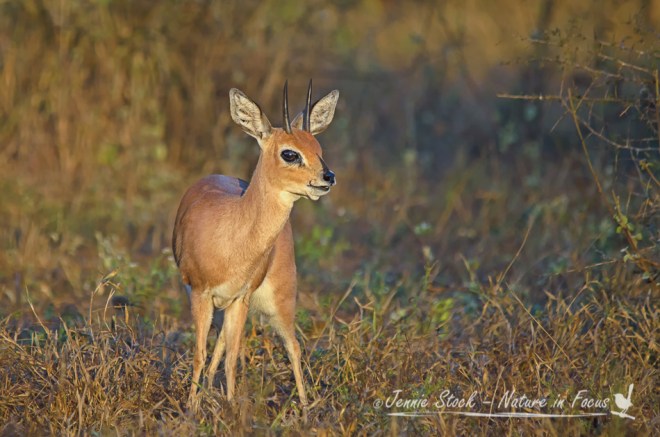
This male steenbok seems to be twisting himself in knots, trying to decide whether to freeze or flee. You can’t really blame him – steenbok are a small antelope and prey for leopards and eagles, among others. I think I’d also be nervous. Looking a lot more relaxed are these impala, the most commonly sighted antelope in Kruger. They even have a flower named after them.
Impala tails
Grooming impala
Impala lily (Adenium multiflorum) – in a garden in the Eastern Transvaal, South Africa
Chewing the cud
Occasionally impala do decide to do something a bit more interesting, besides getting up your hopes of a predator (by all looking intently in one direction for a while). The males below were having a bit of a territorial dispute in between the thorn bushes.
A new discovery for us in Kruger was the hide at Lake Panic, near the Skukuza rest camp. The light wasn’t great when we were there which made bird photography quite tricky but I did manage to capture some of the other aquatic wildlife, like this cute baby hippo and his mother, feeding in the shallows.
Hippo surfacing
Mother and baby hippo
Have they gone?
Crocodile eye close-up
Some of the other inhabitants of Lake Panic were a bit more camera-shy, just peeking their eyes out of the water. More entertainment was provided at other waterholes we stopped at, with a yawning hippo seen from the Tshokwane-Satara road and foolhardy birds trying to use a hippo as a perch at Sunset Dam near Lower Sabie.
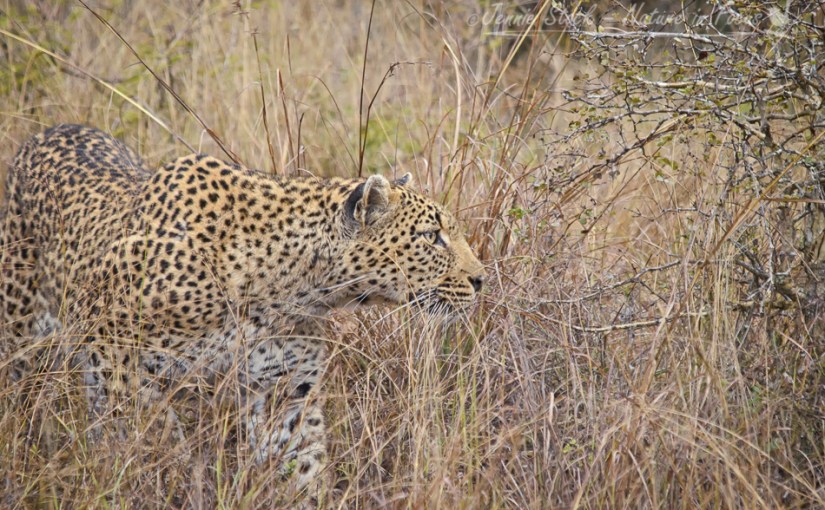
Good sightings of elephant and buffalo quickly knocked two of the Big Five off the list, but the other three proved a bit more elusive. It was mid-week before anyone saw a cat, in the form of a rather distant leopard on the sandbank across the river from Skukuza camp, only seen by some of us who stayed in camp for a break. The next morning three of our group were lucky enough to see the leopard in the main photograph, at much closer quarters. I’m thrilled to have managed some decent images of this cat, as the light was terrible – thank goodness my camera has reasonable high ISO performance. I do love the way she is so camouflaged in the long grass. She was hunting and bolted across the road (terrible pics through the front windscreen) and soon disappeared into the thicker bush on the river edge. I hope she found some breakfast.
Watchful leopard
Long-distance leopard
Where did it go?
We only realised how lucky we had been when we got back to camp for breakfast – we thought some of the others had also seen her but we’d misidentified the car in front of us! At least we all saw the white rhino the previous evening – I’m counting that as part of the Big Five even though strictly speaking I think it is meant to be a black rhino. The term Big Five refers to how dangerous the animals were to hunt on foot, so the black rhino would be more appropriate as they are much grumpier. This rhino didn’t seem very grouchy at all, having a moment with a starling on the road before drifting off into the bush. I just hope it gets to live peacefully and keep its horn – Kruger is not immune from the current rhino poaching epidemic.
White rhino with starling
Rhino in long grass
Our last tick on the Big Five list was lion – not a very exciting sighting but at least we saw them, on a sandbank next to the river on the way from Skukuza to Lower Sabie. Lazing around as is usual for lions, for all the world as if they were on a summer holiday. If you look carefully at the one on the left, it has a radio-tracking collar around its neck.
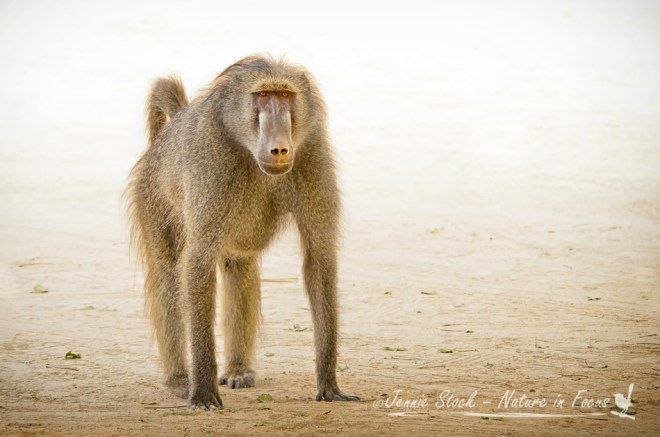
This large male Chacma baboon turned out to be a rather scary problem at the Nkuhlu picnic site in Kruger. I took this picture when he came to see whether we were getting food out of the car (only money and cameras); later when my sister did have food in her hand he ran very aggressively towards her and she ended up having to throw the food at him. Apparently our group was an easy target as it was an all girls expedition (no dominant male!). Baboon troops did seem to be causing lots of hassles at many of the picnic sites in Kruger, always looking for an easy meal. The staff do their best to discourage them – at Tshokwane the weapon of choice was a handy till roll, wielded very accurately.
Young baboons
Where did they go?
Baboon youngster
Baboon chasey
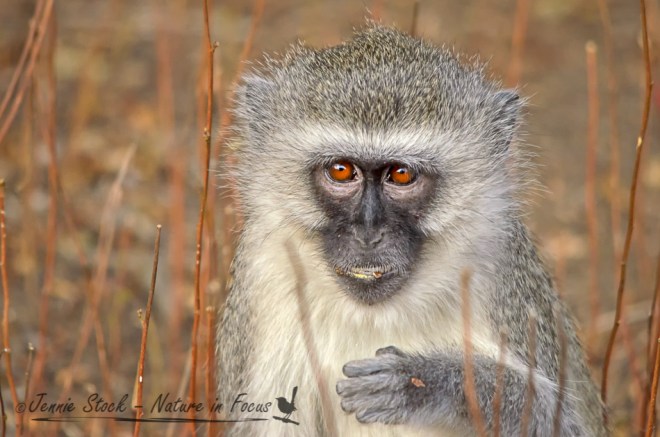
The youngsters were still fun to watch from the safety of the vehicle. These guys were having a wonderful time chasing each other up and down the tree, just like a bunch of school kids at recess. Fun as the juvenile baboons are, I still prefer Vervet monkeys. I think they remind me of my childhood – growing up in an area where there was still lots of natural bush and troops of monkeys that used to race across the roof, ignoring the dog’s frantic barking.
Vervet monkey catching the sun
Damp vervet monkeys on branch
I love the way they sit with their tails hanging straight down, grooming each other even though they were rather damp from the earlier rain. They have very sweet faces; somewhat misleading as they can be just as much of a pest as the baboons. My niece was keen to adopt the cute young vervet in the picture below, but we persuaded her to make do with a fluffy toy.
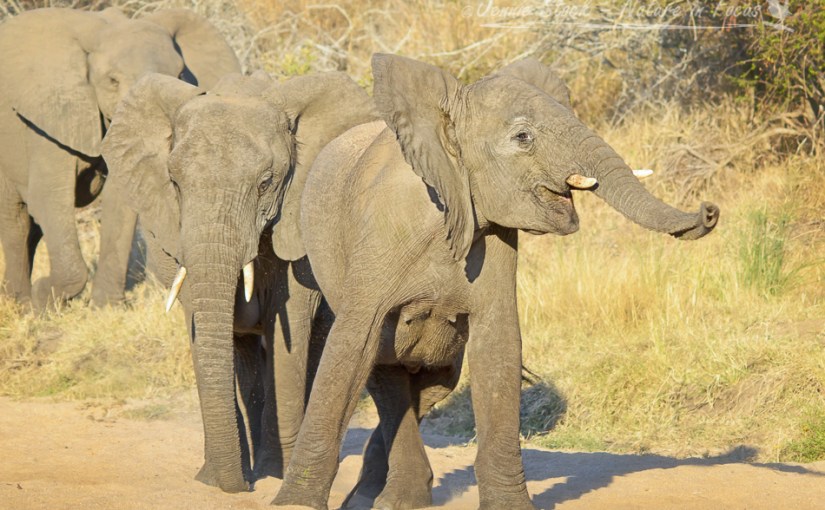
This young elephant gave us a bit of an uneasy moment when it started shaking its head and trunk. They were quite close and moving towards where we were stopped on the causeway, level with the river bed. Luckily it was just having a bit of a shake. The small herd crossed just in front of the car; quite a memorable experience. I’m really happy to have captured the moment without missing a bit of foot or trunk. After this they were too close for my big lens – sometimes you just have to enjoy the scene and forget about taking photos for a bit. The images below were taken after they had passed the car and were heading back into the bush.
Baby elephant following mum out of the river bed
Young elephant in river bed
I have decided to abandon the ‘daily diary’ I was doing for my posts. Instead this post is all about the ellies. We were treated to quite a number of elephant sightings in our week in the park – not a problem as they are one of my favourite animals. Often they were at waterholes or in what seemed like dry river beds, digging below the surface to get at the water. They like to play too, chucking mud and water everywhere. This group had a couple of cute babies with them.
Baby elephant drinking
Elephants looking for water in the river bed
Small baby elephant
Elephants can be quite destructive eaters – not surprisingly, they have huge appetites to match their size. Watching this elephant demolish very unappetizing-looking branches was impressive. They also use their tusks to cause a fair amount of damage to the bark of many trees.
A very pretty Mourning dove in camp at Satara
Satara is a lovely camp – we all wished for more nights there. What should have been a post-lunch siesta time was spent stalking birds, like this lovely Mourning dove, in front of the rondavels (the round thatched huts typical of Kruger). I wish I managed a better shot of the Green Wood-hoopoes; they were very busy foraging for bugs in gaps in the bark of a tree. The Red-billed buffalo weaver was much more relaxed.
Green wood hoopoe (or Red-billed) foraging for bugs
Green wood hoopoe foraging for insects
Red-billed buffalo weaver in Satara camp
During our late afternoon drive heading north from camp, we came across a huge herd of Cape buffalo. I changed to my wide-angle lens to try and capture a sense of the size of the herd. It probably would have worked better if I could have got out of the car and low down, with one buffalo in the immediate foreground – but I wasn’t going to try that. Buffalo may look a bit like cattle but they aren’t one of the Big Five for nothing! Even this one trying to scratch his head looks a bit dangerous, especially when you look at those horns closely.
Huge buffalo herd near Satara
Glossy starling showing off its shiny feathers
Cape buffalo having a scratch
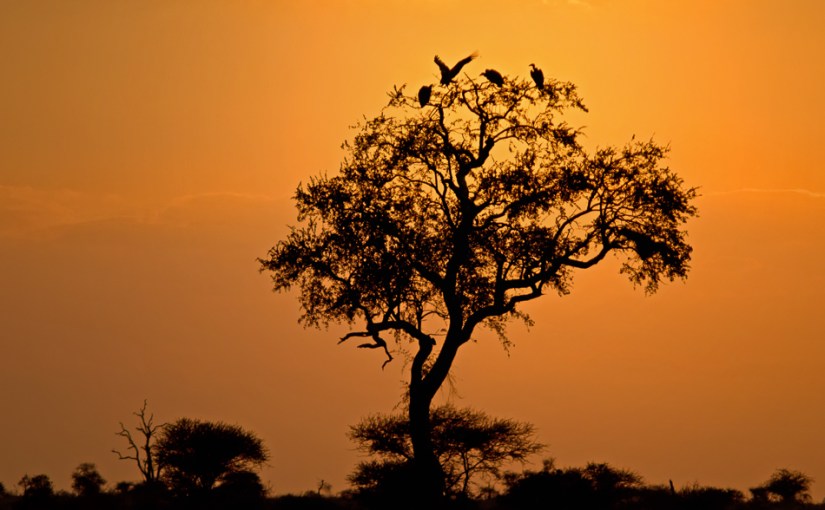
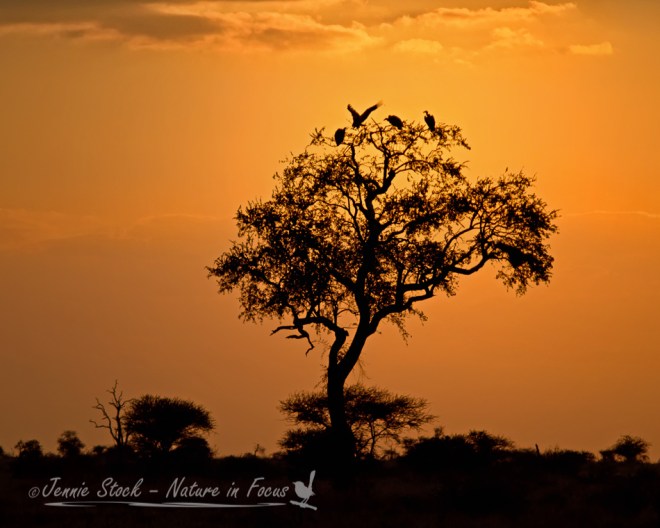
We stayed out as late as we could – as ordinary tourists in Kruger you have to be back in camp when the gates close at sunset. Some vultures hanging about in a tree were intriguing but too far away to see if there was something exciting on the ground attracting their attention. I am glad I managed an African sunset shot – not bad for handheld at 250mm.